

Sally Andrew lives in a mud-brick house on a nature reserve in the Klein Karoo, South Africa, with her partner, artist Bowen Boshier, and other wildlife (including a giant eland and a secretive leopard). She also spends time in the wilderness of southern Africa and the seaside suburb of Muizenberg. She has a Masters in Adult Education (University of Cape Town).
For some decades she was a social and environmental activist, then the manager of Bowen’s art business, before she settled down to write full-time.
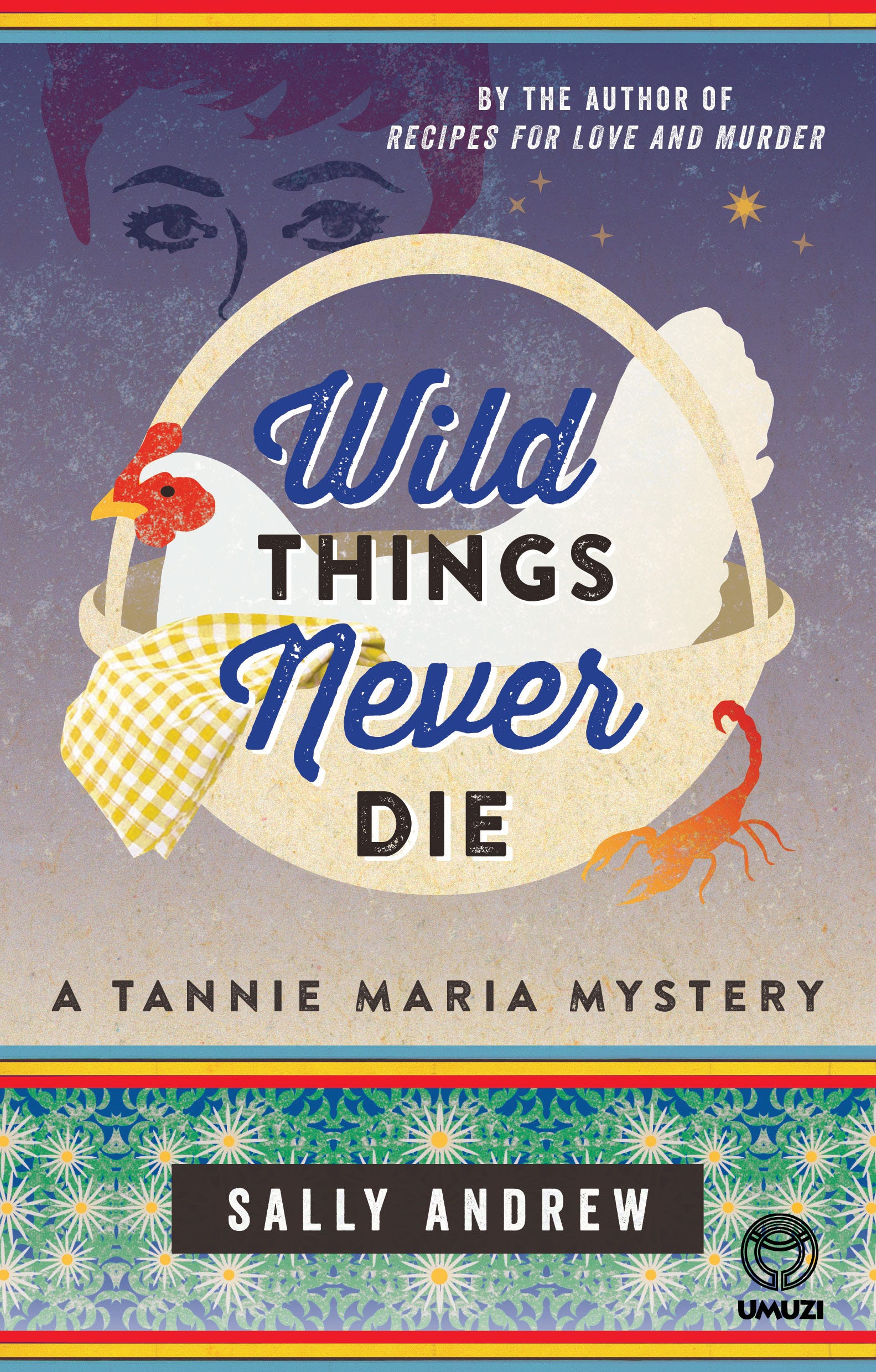
Sally is the author of the Tannie Maria mystery series, set in the Klein Karoo, South Africa. These include: Recipes for Love and Murder, The Satanic Mechanic, Death on the Limpopo, The Milk Tart Murders, Recipes to Live For and Wild Things Never Die, which has just been published.
What is a Free Range Human?
People who live inside ordinary life, but haven’t lost contact with its beauty or traded their aliveness for it. They are wholeheartedly human, astonished and at large. Finding them, and finding out how they got that way, is what this series is about.
Sally and I spoke with her in April 2026 and we talked about beauty, chronic illness and the stories we choose for our own lives.
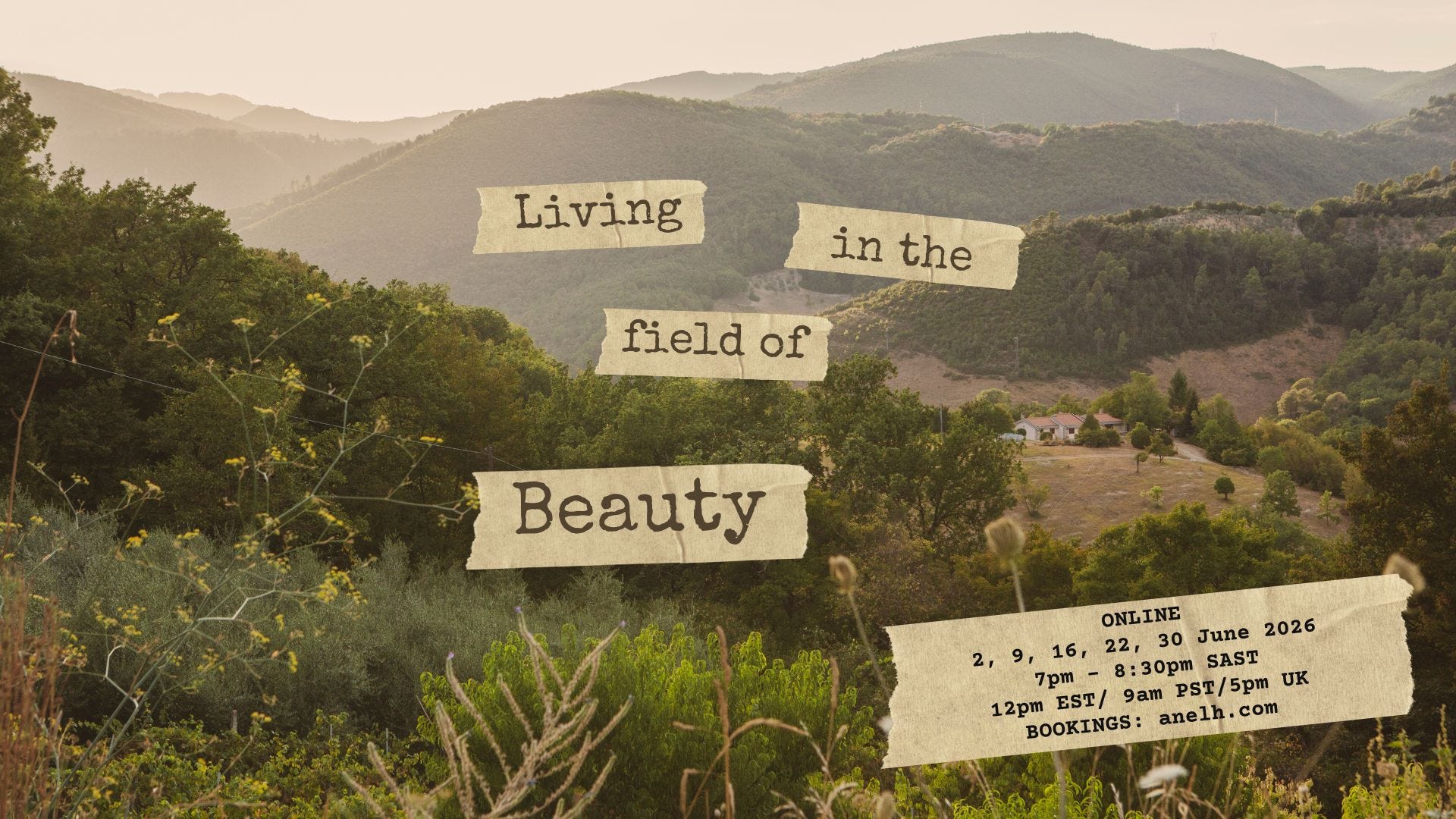
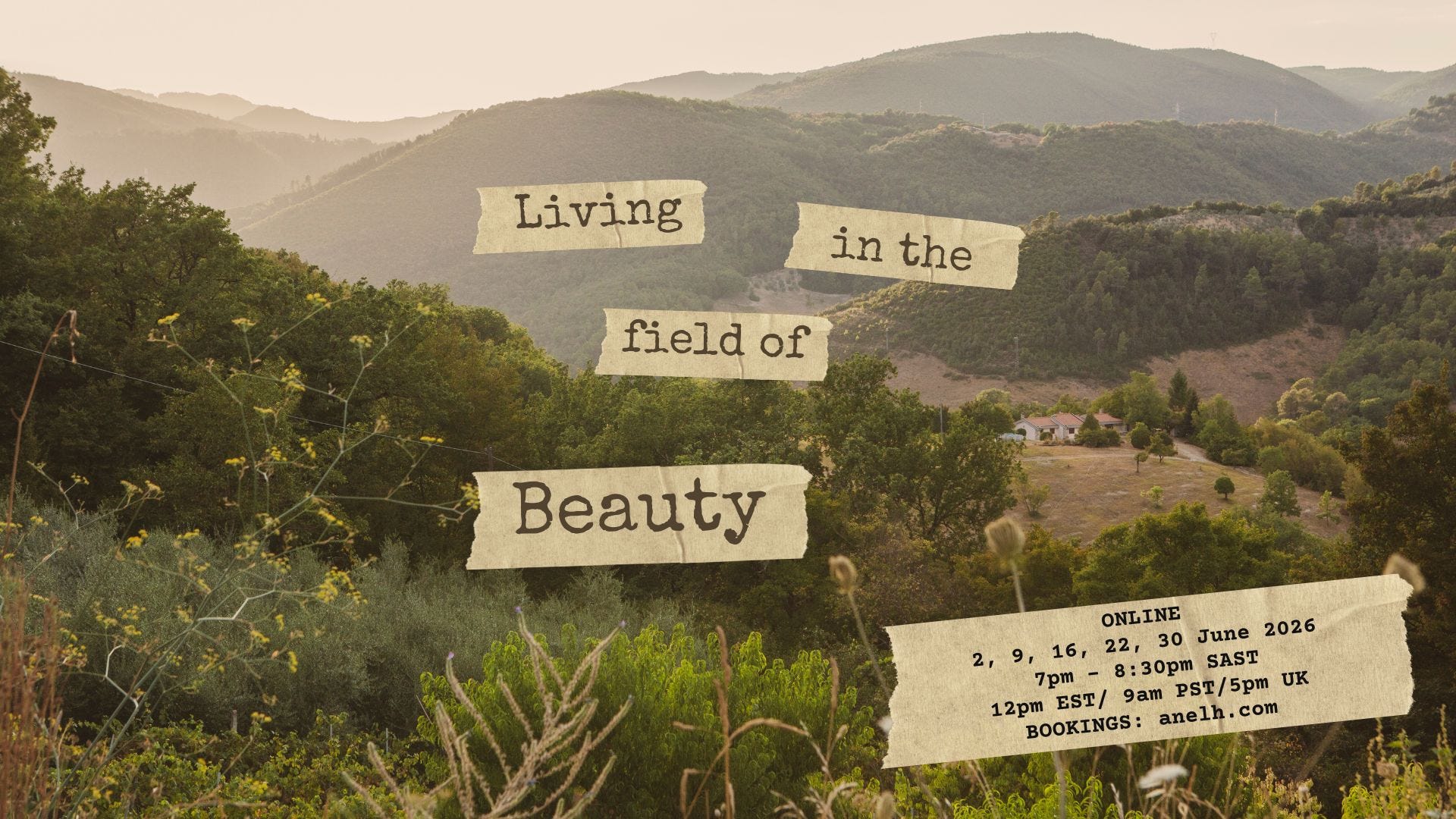
This conversation is part of a series I'm making in preparation for Living in the Field of Beauty, a five-week course starting in June. If you'd like to support this work and get early access to future conversations, you can support me on Patreon.
Invitations to Launches, 2026
You are invited to attend the Wild Things Never Die book Launches. Sally will also be taking part in Franschhoek Literary Festival, Kingsmead Book Fair (Gauteng) and Fynarts Festival (Hermanus).
12 May 6.30, Die Bordinghuis, Wellington with Lorraine Khune, RSVP 0662892212
19 May 6 pm, The Book Keeper, Pretoria with Lorraine Sithole. RSVP info@thebookkeepershop.co.za
20 May 5.30 pm, Love Books, Gauteng with Michelle Constant. RSVP kate@lovebooks.co.za
6 – 1O June, Bargain Books along the Garden Route.
18 June 5.30, Kirstenbosch with Don Pinnock. RSVP tkidelo@penguinrandomhouse.co.za
For more info contact fleroux@penguinrandomhouse.co.za
Prefer to Read?
*This transcript has been edited for length.* Full transcript is available on the post page.
Anél: Would you do me the honor of introducing yourself today? There’s much to say about Sally Andrew and I always think you’d probably do a better job of it than I would.
Sally: It’s an interesting idea, isn’t it? How you introduce yourself, what you summarize your 58 years as.
I spent a lot of time being an activist: anti-apartheid, anti-capitalist, environmental. I finished school in ‘84, so that kept me quite busy. And then I got really ill, and that was a big part of my life for probably a couple of decades. I had ME, myalgic encephalomyelitis, chronic fatigue syndrome. Before that I was driven by what I should do and what I felt responsible for, for the earth, the country, the planet. And I think my illness gave me permission to do some of what I loved, which turned out to be writing.
First it was writing on themes: adult education work around domestic workers, violence against women. Then a book about the environmental crisis combined with personal creative nonfiction, which was such fun. It got published eventually by Findhorn Press under the title Stories for Fire Dogs. I got enough encouragement from publishers who said, if you ever write anything kind of normal, send it to us. So I wrote what I thought was a normal book - fiction about an environmental guerrilla and a San Bushman, called The Smell of Rain. But I was bitten with the pleasure of writing fiction. I worked out I should write in a genre I enjoy, which turned out to be murder mysteries in the Agatha Christie vein - nothing too gory. So I wrote in a genre I love, and I brought into it my environmental interest, my political interest, my psychological interest, my spiritual interest.
So: I’m a writer. I’m also a healer, though a lot of that healing work was learning how to heal myself, which is always how we learn. Now I do something called biofield tuning, working with tuning forks. But there’s more — I’m a partner of 27 years, I’m a daughter to a mother who’s turning 87, I’m a neighbor to some lovely Karoo mense. And I’m an aspiring doo-wop girl. I love to sing, but I’m not a natural singer at all.
Usually at the beginning of one of my launches, I sing a song in public. It’s terrifying, but it gives me a focus.
Anél: Tell me about that… It gives you a focus?
Sally: Then I don’t worry about what I’m going to say. I’ve got a super overactive brain, and when it’s linked with anxiety, it can disable me, disturb my sleep. So at a launch, if I’ve got something like what outfit am I wearing and what am I going to sing — I’ve got a little irrigation pipe I’m going to play — then I can focus on that. Every time I think, who am I going to forget to thank? Is Anél coming, and will I remember to thank her properly? I just go back to practicing the song.
Anél: I love that. That is exactly why I think you’re a free range human. You use play and expression in a way that allows you to slip out of the anxiety. That’s phenomenal.
Sally: Tricks, tricks, tricks. When you say I’m a free range human, I’m not really - I’m full of my own angsts and troubles and journeys and problems. But I’m always getting more free of them. I’m always seeking the play. And when I’m in a stupid habit, I stop it. That’s what the lightning process actually is: a training process. You stop, you see the pathway you’re on, and then you choose another neurological pathway and you build that. You shut down the highways of stress and you build rivers of joy, rivers of play.
Anél: I think for me, free range humans are people who have the ability to think for themselves, make their own lives, live on their own terms. And I think you have that. I want to go back. You mentioned your 87-year-old mother.
Sally: She’s eating the chocolates and drinking the wine. My books were delivered with chocolates and wine, and I said she can go ahead.
Anél: I wonder if you think your mother is a free range human, and if she’s impacted your ability to be one.
Sally: My whole family, definitely of a more free range variety. My dad — at his events, his celebrations, you celebrate and you provide entertainment. That’s part of what you offer. So he trained us to do that. I was once giving one of my nephews a lecture about why he hadn’t held down a job, and then I looked around at all of my family and all of my partner Bowen’s family, and none of us have worked for other people for more than a few months. We’re all self-employed. We’re not used to bosses.
My mother’s definitely a wild thing. She really dances to her own rhythm and plays her own games and she’s the queen of her domain. Still at 87, full on the queen, and incredibly emotionally sharp, just driving her own destiny on her own terms. And also very driven by love. I think any true freedom comes from love and connection. The people who can help you learn how to love give you that freedom.
Anél: So what is love? What is this love business?
Sally: This is actually quite a big theme in my latest book, Wild Things Never Die. The themes are choosing connection over control and love over fear.
I think love is... there’s that mushy feeling you sometimes get, and you just learn to expand it. But I also think love is this neutral thing that happens when you stop giving yourself and others trouble. It’s kind of a natural state of being, especially when I’m in nature and I’m not fussing and not worrying. So love is less of an activity and more what remains when you stop putting effort into being tense, into putting yourself down, into wanting to be something you’re not. All the things we’re encouraged to do by the ego-driven you’re-not-enough mentality. From tuning work I’ve discovered it’s almost like a virus in most humans, this notion of not being worthy. As soon as we stop doing the rubbish, we fall into a natural state of love, because the things around us in nature are so beautiful.
Sometimes when I’m in the right state, I’ll see a little Karoo violet on the ground - this little posy of grey leaves and then this deep, soft, velvet purple. It’s just so unnecessary. It’s an act of love. When I first saw one, I just fell down on my knees and cried. Look at this gift from the earth, for me to see. There might be not another human who sees it.
That’s what happened when I stopped doing the nonsense. One could also see it as a left and right brain thing - Jill Bolte Taylor, who wrote Stroke of Insight. When you stop the left brain worrying and planning, which is very useful and your brain is trying to help you, trying to protect you. Thank you, brain, you’re amazing, but you’re not the boss. You move into that right brain state. And in the right brain, which is also what you get to experience more when you dance, when you sing, when you write, when you walk in nature, you fall into the natural state of love and connection. That’s my theory today.
Anél: I love that. I’m reminded of the previous interview I did where we spoke about the world wanting to be admired by us. When I have that image of you looking at the Karoo earth and seeing that flower, there’s something about the beauty of admiring it and the world going, yes, thank you Sally Andrew for seeing us, for being with us.
Sally: That’s very interesting. It’s something Bowen, my partner who’s an artist, has always said to me that nature and earth loves being appreciated. I’d always seen it as a one-way street, this beauty and food and air there to serve us. But more recently, I touched on this in the book: even our out-breath, the tree breathes in. We’re actually useful. We’re not like nasty little viruses, which I used to think, when I was doing only environmental work, that we were just horrible little viruses the earth should shuck off. But in our natural, free range states, literally every breath we give is breathed in by the tree, and they love it. They love being loved.
I’ve noticed when I talk to trees, for example, they really love the birds. I met this leadwood tree in Botswana that was so sad because the bird that usually returns hadn’t come back that year. I relate to that. If our swallows didn’t return in September, it would be sad. Nature has this passionate connection.
I also like to believe the ether itself is made of neutral, beautiful love, and even the ugly stuff that happens is part of the interesting experiment that makes us grow and evolve. But that’s my story. I think it’s important to make up a good story for yourself that’s good to live. There’s a lot we don’t know. If you can make up a story that gives you a happier life and an easier relationship to death - yours and others’ - and it doesn’t have any downsides, even if we don’t know if it’s true, then make up a good story and fit things into it.
Anél: I suddenly have this memory of having spent time with your family, going to one of your family gatherings where it’s completely normal for everyone to come and do a performance: say a poem, tell a story, sing a song. We used to do that when we were children in my family in the 60s and 70s, before television. I think it was probably a lot more common then.
Sally: We were definitely expected to entertain each other, and encouraged early on to be brave, to stand up and say and do something in front of people.
And you’re doing the performance not for the accolade. You’re doing it as a gift for others and as something that feels good for you. At launches, for example, I’d much rather not. I like to sing and dance, but I’d rather do it by the river with a bunch of friends. I don’t thrive on being the center of attention. But I feel it’s a ceremony of gratitude to people who are making it possible for me to sit and write my books and spend most of my time under a rock in the Karoo or in a stream or doing creative work. So it’s an act of celebration and gratitude.
Writing a book and making a living from it are two completely different things. You need a whole team to help you, and a lot of readers who each add up their small royalties to make enough for a living. It’s a group project. So I step out of my comfort zone. It takes energy, and I usually don’t sleep well in that time. But it’s learning about performance not as a way of showing off, but as a way of giving entertainment — and ultimately a freedom of expression.
Anél: You’ve also got a natural ability to express yourself fully in the moment. When you feel something, you can acknowledge it and be with it completely.
Sally: I think it’s something you may relate to. It’s the gift - initially the curse, but also the gift - of healers: being able to feel into something and process it instead of pushing it down. When we push down what we feel, we get sick. As highly sensitive people in the healing and creative arts, we feel things strongly. We need to learn how to manage that. For me, most of it was running away - I can’t read the news, I’m coming to live in the Karoo. But I’ve learned, mainly through the tuning work, how to ground myself and how to let something move through me.
Jill Bolte Taylor says an emotion takes a minute and a half if you let it move as a wave. I let it move through me, I ground it into the earth, and then that person I’m working with feels amazing. This thing that used to be a curse - you’re too sensitive - becomes something you learn to use and manage, both in creative work and in healing emotions for yourself and others. Because that’s what healing really is. There’s stuck, blocked things in us. And there are different ways we let them be free. Every healing modality is essentially finding freedom, relaxation, so your natural order can do its thing.
Anél: Okay, so let’s go deep. We’ve both had this thing called ME.
Sally: Enough said. Myalgic encephalomyelitis, chronic fatigue syndrome, yuppie flu.
Anél: That thing that we’ve both had, and that’s really why I started this project. When I turned 50, I suddenly went — what if I never recover? I’ve had this thing for 16 years. I’ve gotten better and gotten worse, better and worse, and if I’m never going to be well, how can I still have an inner sense of aliveness and connection and love and beauty in how I relate to the world? How can I be a free range human without an athletic body, running around outside in the chicken yard like other people do? I’ve had the privilege of watching you learn these healing modalities, the lightning process, biofield tuning, and slowly seeing you come into life in this more full and expressed way. What did you learn about aliveness from chronic illness?
Sally: Well, now I can come first in my age category at parkrun, and I still can’t get over it after all those days of lying down. There were times I couldn’t brush my hair. And people can’t see it, they don’t understand it, so they think you’re just being a lazy git, or just depressed.
I’m so grateful I had ME rather than depression. With ME you can still have a little bit of that free range thought, you can still be happy and smile, but your body is stuffed. It’s immune system — one theory for me was an overactive immune system, so learning to totally chill, which I still haven’t really learned.
Since being ill, I have become more free range. Because there were so many things I couldn’t do, and now I just must not do them because someone might look at me funny? No. Now whenever I can swim or run or dance — I go to Nia dancing with Gail Schoeman when I’m in Cape Town — it’s just leaping around with nymphs in the forest, this freedom of body movement. Just stepping into the joy of being alive and the gift of having a body on the earth, after all the years of a body that just didn’t work. It gives a bit of perspective.
And even when I was utterly vrot, I’d appreciate being able to walk for ten minutes. So it’s definitely helped me appreciate. I haven’t taken the Buddhist approach of acceptance. I didn’t accept my suffering for a minute. I mean, I live with it, I know it’s there, but I’m always looking — if this doesn’t work, what’s that? There must be a way out. There are so many healing modalities, so many offerings, so many ways of pursuing. And I’m always chasing them, I’m driven. The drivenness has got me far, but I’m also now learning to receive without being driven.
Sometimes I get thrown. But I like to believe the whole universe is there cheering for you. And if I’m pushing too hard or trying to control something too much, I’m not listening, not receiving, I’m stuck in victim mode. That doesn’t mean there aren’t times to mourn. I’ve done a lot of grieving. I haven’t had kids. My career started decades later — I was 48 when it took off, which is not early. I could do a lot of grieving and victiming, and acknowledging loss and sadness is right and fine and not to be judged. But being stuck in a victim state doesn’t take me forward.
Anél: How did you keep moving forward? How did you not become bitter and just close the door?
Sally: It’s a constant choice, and I’ve certainly done those things. But I’ve had enough fun and beauty that I’m close to and that I pursue to keep me going. If there’s a stream I can climb into, it brings me joy. So just following what gives me pleasure, really. The writing gives me pleasure, living here gives me pleasure, dancing, singing.
I also get into routines, which really help. If I exercise, write, and do tuning in a day, I’m just damn happy. And there’s something Kipchoge said — the long-distance runner — only the disciplined are free. Otherwise we’re at the whim of our weird moods and other people’s weird moods. When I run here in the Karoo with the trees and the birds and the light, I just feel so good. So the discipline is also following what I love and what makes me feel good.
And it feels good to do good things for others. Yesterday, I sat for half an hour and held Ouma’s hand — she’s 102, she can’t stand up anymore. I just ran this current of love through her body, holding both her hands. Slowly her repetitive loop of “I’m so sad, I’m so lonely, you don’t know what it’s like” shifted, and between the loops there’d be “I’m so grateful to have you here and this place is really good to me.” She said, you can come every day. That pursuit of feeling good in yourself spreads.
Anél: So Sally, what is your relationship with the word beauty? How does beauty fit into the life of a Sally Andrew?
Sally: I’m very aware of it in the physical beauty around me — nature, the birds, the flowers. I’m just in awe of this unnecessary, extreme beauty. Every sunset, every cloud is just these artworks all the time. I feel beauty is the reward for sticking it out on earth. It’s the antidote to suffering. And it’s always available in nature. Even if you can only see the sky, the clouds are just there.
It’s a bit of a catch-22: you’ve got to get out of your headspace to see the beauty, and you’ve got to see the beauty to help you get out of your headspace. But the thing I’ve more recently experienced is becoming part of the beauty. As a feminist and a socialist, I’ve rebelled against a lot of the prescribed notions of what beauty should look like. I only discovered lipstick in the last five or ten years. But I had this moment at the old beach near Boulders — surrounded by sparkling water — and I suddenly felt I’m in the beauty. I’m not looking at the beauty. I’m of the beauty. And it was so strange that I should ever have separated myself from it.
Now I aspire to be beautiful. Not in a judgment way — I still struggle with photographs taken from under my chin, I’ve got the vanity and my body’s changed and I’m adjusting. But I want to radiate beauty. Look at those birds — they’re all being beautiful. It feels like my job to also be beautiful. In that physical sense too, I’ve realized it’s the radiance that matters. You can have people who are cover models, photoshopped, everything done — and I don’t necessarily feel beauty from them, unless they smile and they’re open-hearted and they love. And then sometimes you see someone who doesn’t have the prescribed beauty, but they’ve got this lovely smile, and you see the physical beauty in them. So it is a physical thing, but it’s shaped by radiance.
Anél: And Sally, you create beauty with your books. Every time somebody reads one of them, there’s such a genuine sense of capturing something that imparts connection and love and hope and playfulness. You’re able to take the beauty that exists within you and assemble it in a way that you can give to other people. There’s such a magic in that.
Sally: And a lot of it is the physical beauty of the Karoo, the birds and the trees and the dynamics and the interactions. A lot of Tannie Maria’s peak moments are ones I’ve had, or variations of them.
Anél: What does it feel like when you write a book and then other people read it?
Sally: It’s wonderful. And it’s a thing — the physical beauty of the place, of nature, but also of interactions between humans and of the relationship with the self. Because Tannie Maria, in this book, struggles with the fear of the dark, her relationship to wilderness and fear and connection. And it’s lovely to be able to share that in an accessible way. I have some notions that are my own epiphanies and feel really profound to me, but through Tannie Maria — who’s so grounded and real, an overweight Tannie in her 50s, very kind — I can bring them down to earth.
A bit of background for those who don’t know her: Tannie Maria is an agony aunt who lives outside Ladysmith and writes for the Klein Karoo Gazette — Tannie Maria’s Love Advice and Recipe column. People write in with their problems and she writes back with some common sense, grounded advice. She’s half Afrikaans, half English — thank you in part to Anél’s advice, who read an early draft. Her half-English side allows for her quirky, left-field thinking. She loves to cook, she gives recipes as part of her advice, and she gets involved in solving murder mysteries alongside her young journalist Jessie and her fiancé Henk Kannemeyer, a policeman.
In this next book, Wild Things Never Die — book five — she’s staying on a Karoo wilderness reserve, battling with succulent poachers. In each book there’s an environmental or political theme, there are murders, and there’s her own personal journey. She was abused by her first husband and she’s been slowly opening up, overcoming fear, connecting with love, working through different things in each book. In this one, she has some extraordinary encounters with the white lions of San Bona. It’s like a peak spiritual epiphany.
All the stuff that happens in my life that feels important or profound — politically, socially, spiritually — I bring down to this very grounded, straight-talking Afrikaans Tannie. So everything she presents is very real, accessible, and usually quite funny.
And it overlaps with whatever I’m going through. This book was dealing with fear, and somehow directly and indirectly, I cleared a lot of fear in writing it. I used to wake up with a kind of terror in my tummy, even when I was physically well, and I don’t have that anymore. I teach Tannie Maria and she teaches me, and we hope it reaches other people. We hope we choose archetypal things that will help humans become more free range, enjoy beauty more, and be kind to each other.
Anél: Sally, you keep coming back to biofield tuning. It feels like such a central part of your healing journey and where you are now. Please tell us a little about what it is and what it’s done for you.
Sally: So for those who want to look it up more, there’s a website - www.biofieldtuning.com - where I’m listed as a practitioner. In brief: biofield is essentially the science name for the electric field around us. We know our brains are electric, we know our hearts are electric. We are basically saltwater batteries, with a field around us shaped a bit like an apple - what’s called a torus. And working with sound through tuning forks allows you to engage with us as vibratory, electric beings.
The short version of what happens in a session: the fork picks up areas in the field that are a bit off, you can hear it, feel it, and then it works with what’s called entrainment, returning you to your natural harmonious state. Like rings of a tree, the information at the edge of your field relates to the beginning of your life, and the closer to the body, the more recent. You move through the field, picking up areas of static or dysfunction and grounding them. What was flat and muffled becomes bright and clear, and you bring it back into the body.
There’s also a loose map that emerges, certain themes tend to show up in the same places in the field for different people. And it can be done at a distance, which I didn’t believe at all until I started testing it.
[*Editor’s note: Sally goes into much more detail about the technical and experiential dimensions of biofield tuning in the video interview — it’s well worth watching if this resonates with you.*]
The outcome is what matters: people healing mental stuff, physical stuff, thyroid problems, back pains, all sorts. I do group sessions where we measure calm energy and joy out of ten before and after, and people move from like three to nine in half an hour. And I get energized doing it, as long as I ground properly.
Anél: Thank you so much for taking the time to sit with me today.
More Free Range Human
Watch my conversation with Peter van Straten.
Watch my conversation with Maja Marx.
Sign up for Living in the Field of Beauty, starting in June, here.
Join me on Patreon.
More about Free Range Human.


