
Making the World Strange Again
And why re-enchantment can save us

“Late have I loved you, O Beauty ever ancient, ever new, late have I loved you. You were within, and I was without, and there I sought you. You were with me, but I was not with you. You called, you shouted, and you broke through my deafness. You flashed, you shone, and you scattered my blindness.” St Augustine, Confessions
A Very Polite Simulation of Being Alive
You get up. Make coffee.
Outside, the sky shakes out its wings and unfolds in all its morning splendour. You peer through the window, grateful it matches the weather report.
You join the daily choreography, swiping and nodding. You say things like “Sure, sounds good!” and “Let’s circle back” with the calm authority of someone fluent in the performance.
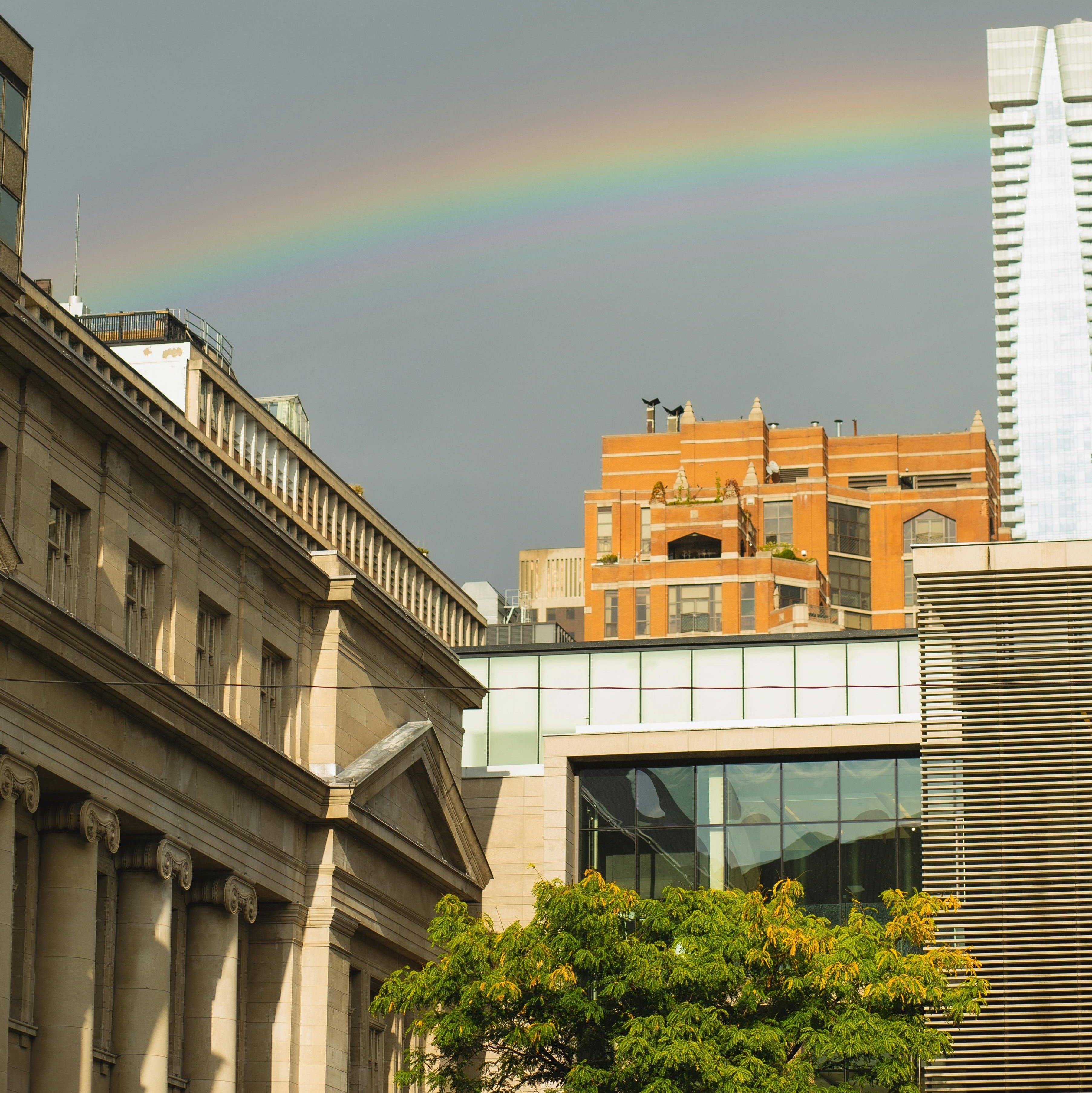
You pick up the kids and realise you can’t even recall the drive. The clouds part and a rainbow appears. “Look, kids, a rainbow!” you say, pointing to the sky. How nice. But it doesn’t really… touch you. It’s more like a background screensaver, something to wade through on your way to your next meeting.
Sometimes you think back to your childhood, a time when the world felt … stranger? More alive. That was a long time ago though, and anyway, that stuff is for kids. Rain is precipitation. Trees are oxygen machines.
You can’t pinpoint exactly when it changed. There was no dramatic crisis. The magic just slowly receded into the dark, and what remains is a vague but persistent longing for something you can’t quite name, but you somehow know is essential.
Somewhere beneath the smooth surface of competence, a thought flickers.
What if the world is actually wild, sacred and alive, and you’ve just been experiencing it in airplane mode?
More than a century ago, Max Weber described this feeling as ‘disenchantment’.
When the San people of Southern Africa realised that Laurens van der Post couldn’t ‘hear the stars singing’ they cried for him. And who could blame them?
The San were deeply enchanted people. Embedded in the natural world, they moved through landscapes thick with meaning. Animals were their kin: teachers and beings with their own agency and knowledge. The land held memory and offered reciprocity. The world was a place you participated in, listened and responded to.
But as rationality and science became the dominant lens through which we view the world, the texture and quality of our experiences dulled.
The philosopher Charles Taylor calls it the buffered self.
It’s as if by naming and explaining things in good and practical ways, we wrapped ourselves up in intellectual cling film and safely sealed ourselves off from the real world.
Without enchantment tugging the soul outward into wonder and reverence, our attention contracted and folded inward. Meaning is no longer woven into the fabric of things. We have to construct it for ourselves, internally, through projects of self-optimization and identity curation. Purpose has become something you manufacture rather than encounter. Mel Robbins is making a fortune.
The disenchanted world is a world of explanations without presences, of information without intimacy. We can name everything and feel connected to nothing.
We’ve become very well-informed zombies.
Welcome to 2026.
The Right Brain
In The Master and His Emissary, psychiatrist and philosopher Iain McGilchrist offers his own diagnosis of how we ended up here.
Your two brain hemispheres attend to the world in radically different ways.
The right hemisphere offers a wide, relational form of attention. It takes in context, mood, and meaning as a whole. It registers situations rather than isolating objects, and experiences the world as something you are already participating in, embedded within its textures and relationships.
Imagine sitting around a campfire with friends at night. You are aware of the circle of people, the closeness of the forest, the warmth on your skin, the cadence of conversation and silence. Nothing needs to be brought sharply into focus for the scene to make sense. You know where you are and how you belong there through felt presence rather than analysis.
Now imagine switching on a headlamp and pointing it straight ahead. This is left hemisphere attention. Awareness tightens and aims. A narrow portion of the world is pulled forward and clarified. You can see precisely where to place your foot or which knot needs tightening. The night breaks into workable segments. This mode excels at planning, measuring, fixing, and getting things done.
McGilchrist’s argument is not that one way of attending is superior in every context. His claim is that these forms of attention were never meant to operate on equal footing. The wide, contextual attention of the right hemisphere is meant to orient us within the living world. The left hemisphere’s focused attention evolved to serve that larger orientation by handling detail, manipulation, and precision.
Since the Enlightenment though, Mcgilchrist argues, Western civilisation has gradually inverted this relationship. Our cultural attention has increasingly prioritised control, efficiency, certainty, and extraction. When instrumental attention becomes the dominant way of knowing the world, nature turns into resource, relationships into transactions and meaning into something that must justify its usefulness.
The consequences are written everywhere. Ecological collapse, widespread anxiety and depression, and a creeping sense that something essential has gone missing, even as our measurements become more exact.
The left brain stands in front of the rainbow with a spectrometer, quietly satisfied with its refraction data, while the right brain keeps tugging at its sleeve saying:
Hey. Look up. It’s beautiful.
What’s Happening
My name is Anel. I was initiated as a traditional doctor in South Africa 25 years ago. It was something I fell into, rather than something that I sought, and a great gift that I will always be grateful for. The process irrevocably changed my worldview and introduced me to a re-enchanted world in a very tangible way. Since then all my work has been a response to this experience.
As we move deeper and deeper into the world of screens and narrowed attention, this substack offers a space where we can re-member our humanness together.
This channel - Free Range Human - is a space where I’m going to be exploring -re-enchantment, beauty, creativity and play. Over the next few weeks I’m going to be interviewing a few artists who, in my opinion, live in an re-enchanted world.
Sally Andrew, author of the ‘Tannie Maria’ novels, is one of these people. Derek Gripper, world-famous guitar player, is another. Maja Marx and Peter van Straten are both Cape Town-based artists that see the world in a beautiful way. Together we will explore how perceiving beauty may offer us a ladder back into enchantment. If you want to receive these videos, please subscribe and follow.
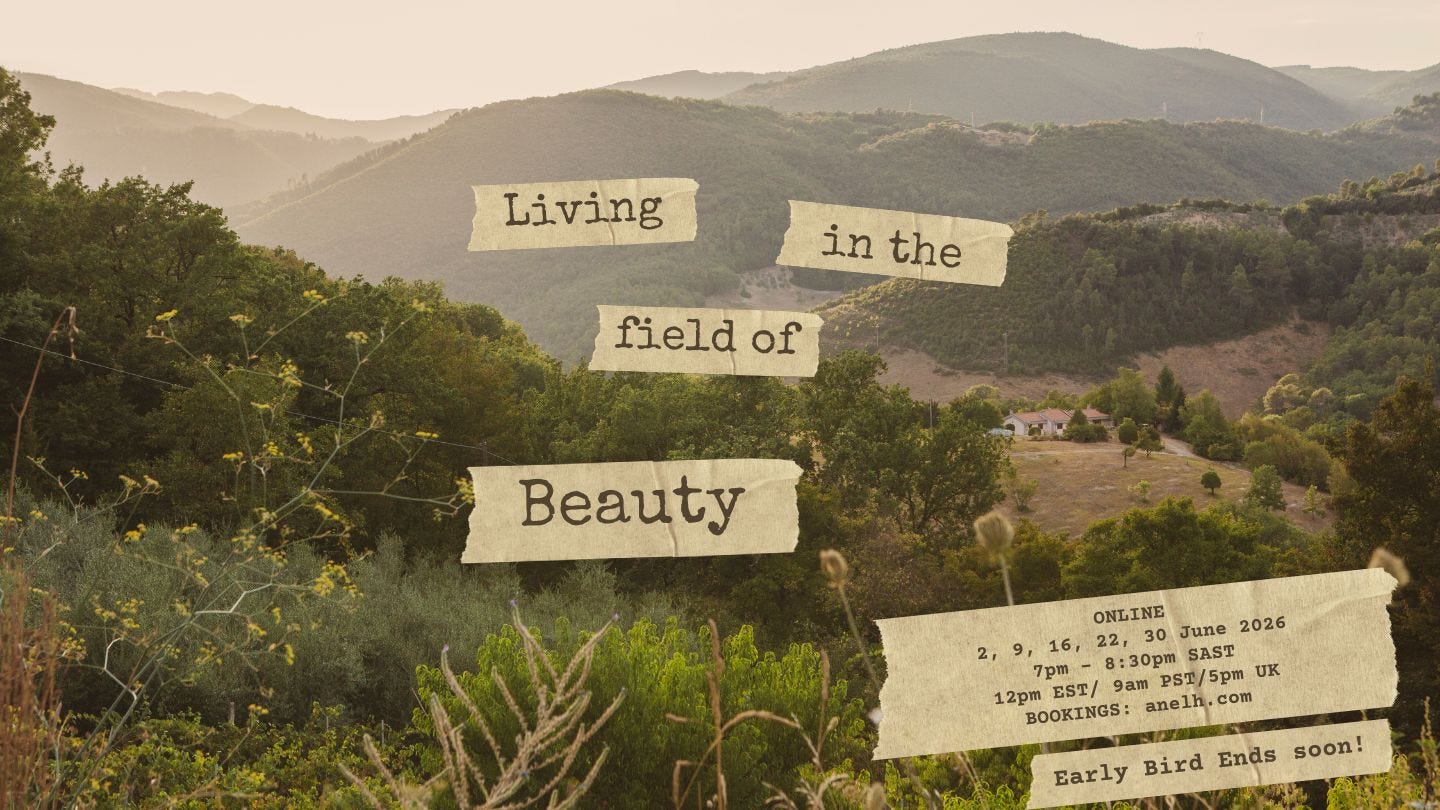
Lastly: In June I’m running an online, 5 week course where we will explore practices that support re-enchanting the world.
This is a 100% reader-supported publication.
Free Range Human is part of a shared effort to re-orient how we live, notice and relate to the world. If you want to be part of that shift and help keep this work independent, you can support it by pledging a few dollars a month and joining the wider community forming around these ideas.
I leave you with this poem by David Wagoner:
The Silence of the Stars
When Laurens van der Post one night
in the Kalahari Desert told the Bushmen
he couldn’t hear the stars
singing, they didn’t believe him. They looked at him,
half-smiling. They examined his face
to see whether he was joking
or deceiving them. Then two of those small men
who plant nothing, who have almost
nothing to hunt, who live
on almost nothing, and with no one
but themselves, led him away
from the crackling thorn-scrub fire
and stood with him under the night sky
and listened. One of them whispered,
Do you not hear them now?
And van der Post listened, not wanting
to disbelieve, but had to answer,
no. They walked him slowly
like a sick man to the small dim
circle of firelight and told him
they were terribly sorry,
and he felt even sorrier
for himself and blamed his ancestors
for their strange loss of hearing,
which was his loss now.
On some clear nights
when nearby houses have turned off their visions,
when the traffic dwindles, when through streets
are between sirens and the jets overhead
are between crossings, when the wind
is hanging fire in the fir trees,
and the long-eared owl in the neighboring grove
between calls is regarding his own darkness,
I look at the stars again as I first did
to school myself in the names of constellations
and remember my first sense of their terrible distance,
I can still hear what I thought
at the edge of silence where the inside jokes
of my heartbeat, my arterial traffic,
the C above high C of my inner ear, myself
tunelessly humming, but now I know what they are:
my fair share of the music of the spheres
and clusters of ripening stars,
of the songs from the throats of the old gods
still tending even tone-deaf creatures
through their exiles in the desert.